

Friday, 11 November 2016
Classroom Community - Create a Jar Full of Blessings
Are you looking for a great way to build classroom community? This jar is a great way to create a positive classroom community and give thanks. Everything but the jar is included in this bundle. You will find a label, a patterned grid to decorate the jar and a blackline master of "Today's Blessing" forms to use. This is an excellent way to celebrate additional holidays as well. Students will read the blessings as a way to say "thank you" to one another and to those who have enriched their lives in some way.

Sunday, 6 November 2016
Thanksgiving Activities in the Classroom
With Thanksgiving around the corner, it's time to find some fun engaging activities for students to use at centers or as a whole class theme. Below are some of my activities plus a free download at the end:

Thanksgiving Roll a Story
Students will be prompted to tell or write story with a Thanksgiving theme. This unit includes a story prompt sheet, graphic organizers, word lists (Thanksgiving & transition words), rubric and specialty writing paper with full and half lined pages.

Celebrate Thanksgiving with your class by writing about it. Included in this bundle are five activities. You will find 5 quick task writing cards and 5 writing templates for an Acrostic Poem, A Text Message Template, An Invitation, a Friendly Letter and a Word & Sentence Generator activity, word list and specialty writing paper. These tasks are perfect for a bulletin board display or even a big class book.

Silly Sentences have always been a fun way to engage readers in developing grammatical knowledge and reading skills. Fluent readers appreciate creating silly sentences using challenging words. This unit contains subject, verb and complement cards with a Thanksgiving theme. Students will be able to create their own silly sentences while exploring verbs that are not used frequently. Increasing familiarity with these verbs will in turn add some zest to students’ writing skills. These verb cards will make a wonderful addition to a “wow” word wall.



Thanksgiving Roll a Story
Students will be prompted to tell or write story with a Thanksgiving theme. This unit includes a story prompt sheet, graphic organizers, word lists (Thanksgiving & transition words), rubric and specialty writing paper with full and half lined pages.
This product is made up of a fun turkey glyph, a turkey trots to 12:00 math game and a turkey three in a row multiplication game. The turkey glyph comes in two variations: the first one is based on American spelling of the word "color" and "favorite"; the second one is based on Canadian spelling of the word "colour" and "favourite". Turkey Trots to 12:00 encourages students to follow directions based on telling time to 5-minute intervals. The first person to land on 12:00 is the winner. Triple turkey looks at products generated from multiplying numbers 1 through 10. The first person to cover up three products is the winner.
This package includes Thanksgiving letter writing paper and lined paper for emergent and established writers. Art work created includes turkey, leaf, acorn, pumpkin and cornucopia images.
Part-part-whole cards are designed to assist students in computation of number sums. This unit of 25 part-part-whole cards will allow students to practice sums from 2 to 10. The unit includes 2 variations for the numbers 2 and 3 and 3 variations for the numbers 4 to 10. With numbers hidden with flaps, Students can then justify what the missing part is and lift the flap to verify their answers. Cards may be used during a number talks, during guided math groups or for individual assessments.
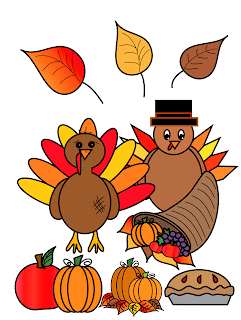
Decorate your resources with these clip art images that include 10 color and 8 black and white images of things related to Thanksgiving. Each image is 300 dpi and in a png format. Below is a listing of what you will find in this pack: apple, brown leaf, cornucopia, orange leaf, pie, pumpkin, pumpkins, turkey character 1, turkey character 2, yellow leaf.
Sunday, 30 October 2016
How to Make a Poppy Wreath
Remembrance day in Canada falls on November 11th. Here's a great way to create a class poppy wreath:

You will need:
- Several sheet of
red paper (8 - 1/2 X 11”)
-Sheets of black
paper
- Scissors
- Glue
- Something to
trace (e.g., small cup)
- Wire hanger
- Heavy duty tape
Instructions:
1. Bend wire hanger into a circle shape.
2. Make several copies of the heart template
using red paper.
3. Cut 6 hearts for each poppy. Crinkle each heart and then glue them
together.
4. Use a small cup to trace a black circle. Cut the circle and then cut small fringes
into the edges. Glue the black circle
into the middle of your poppy.
5.
Attached each
poppy to the hanger. Use heavy duty
tape.
6.
To create a full
effect, add at least 10 to 12 poppies to the hanger.
Poppy Wreath Assembly Photos
You may download the entire free assembly and photo instructions here:
Sunday, 23 October 2016
Halloween Activities in the Classroom
Each Halloween, my classroom becomes a series of Halloween activities for about two weeks. Here are some fun things to do to support math and literacy in your classroom:

Recount Writing: Our Best Halloween Costumes
This is a great home-school connection or addition to your literacy writing station. Students are encouraged to write about their best Halloween costumes. A helpful planning sheet is included for your struggling writers. This writing activity will encourage writing at any grade level.


Recount Writing: Our Best Halloween Costumes
This is a great home-school connection or addition to your literacy writing station. Students are encouraged to write about their best Halloween costumes. A helpful planning sheet is included for your struggling writers. This writing activity will encourage writing at any grade level.
This package includes Halloween letter writing paper and lined paper for emergent and established writers. Art work created includes kids in costumes, jack-o-lanterns, spiders and bats.
Silly sentences have always been a fun way to explore sentence building and recognizing parts of speech. Students in grades 3 through 6 will have the opportunity to use subject, verb and complement cards to build and simplify silly sentences. Challenging verb cards are included with this unit as well as nouns associated with the Halloween theme, a blank sentence building template, display and label cards and a synonym chart. This is a perfect activity to use in your Word Work Stations or as an extra project for early finishers.
Halloween is always a fun time of year to introduce writing forms to your students. This unit contains three forms: descriptive writing, procedural writing and informational writing.
The descriptive writing component is introduced through an Onomatopoeia Poem. With the creation of words that produce natural sounds, students can come up with a creative way to explore the world of poetry. It is recommended that a Halloween CD be used for this activity. If a CD is not available, you may access the internet for Halloween sounds or have students come up with their own. When writing a procedure, students can come up with a Halloween Recipe that will send shivers down the reader’s spine. A step by step “how to” activity is included to assist in the procedural writing process.
Finally, the informational piece is always a fun one that allows students to publish their work on specialty writing paper. Students will explore fascinating facts about bats and explain why bats exhibit certain characteristics, habits or features.
This writing kit includes a writing guide to assist your students, writing forms, display ideas and book covers (if you choose to turn these into class books), specialty writing paper and a rubric.
The descriptive writing component is introduced through an Onomatopoeia Poem. With the creation of words that produce natural sounds, students can come up with a creative way to explore the world of poetry. It is recommended that a Halloween CD be used for this activity. If a CD is not available, you may access the internet for Halloween sounds or have students come up with their own. When writing a procedure, students can come up with a Halloween Recipe that will send shivers down the reader’s spine. A step by step “how to” activity is included to assist in the procedural writing process.
Finally, the informational piece is always a fun one that allows students to publish their work on specialty writing paper. Students will explore fascinating facts about bats and explain why bats exhibit certain characteristics, habits or features.
This writing kit includes a writing guide to assist your students, writing forms, display ideas and book covers (if you choose to turn these into class books), specialty writing paper and a rubric.
Halloween Math Stations are a fun way to consolidate learning for students in Grades 3 to 6. This package of activities includes a patterning poster project, word cards, poster templates and a rubric to use after working through terms such as increasing patterns, decreasing patterns and repeating patterns. Two criteria checklists have been developed. One uses the slide, flip and turn vocabulary while the other uses translations, reflections and rotations. A sample poster planner is part of this package as well as images to use in the creative part of the poster. Individual patterning practice activities are included, an addition game, multiplication game and a place value game using numbers between 0 and 99.
Students will be prompted to tell or write story with a Halloween theme. This unit includes a story prompt sheet, graphic organizers, word lists (Halloween & transition words), rubric and specialty writing paper with full and half lined pages.
Halloween images are presented in an organized arrangement by number. Students will learn to recognize the number of objects without counting them. This is called “subitizing”. Incorporating these images into daily number chats provides opportunities for students to work on counting, seeing numbers in multiple ways and learning combinations.
Each page contains 4 of the same image but in different combinations for number chats. You may use one set of 4 images per day. The students can apply the strategies from each picture presented in whole or small group math chats.
Each page contains 4 of the same image but in different combinations for number chats. You may use one set of 4 images per day. The students can apply the strategies from each picture presented in whole or small group math chats.
Part-part-whole cards are designed to assist students in computation of number sums. This unit of 25 part-part-whole cards will allow students to practice sums from 2 to 10. The unit includes 2 variations for the numbers 2 and 3 and 3 variations for the numbers 4 to 10. With numbers hidden with flaps, Students can then justify what the missing part is and lift the flap to verify their answers. Cards may be used during a number talks, during guided math groups or for individual assessments.
Here's a free product your trick or treaters will love: Halloween Loot Bag Tags. Just add a loot bag and goodies before placing this tag on the treat bag.
Saturday, 15 October 2016
TpT Gift Card Giveaway
Hi everyone,
I've teamed up with some TpT authors to celebrate a fellow author's launch of her new store. Michelle Dupuis Education has launched a French and an English store and to celebrate, she's giving away 2 gift cards. Just click on the links below to enter:


a Rafflecopter giveaway
a Rafflecopter giveaway
I've teamed up with some TpT authors to celebrate a fellow author's launch of her new store. Michelle Dupuis Education has launched a French and an English store and to celebrate, she's giving away 2 gift cards. Just click on the links below to enter:


a Rafflecopter giveaway
a Rafflecopter giveaway
Sunday, 9 October 2016
The Number Line as a Teaching Tool
Using the number line as a teaching tool has become a game changer in math class. When visiting math educators' classrooms I have noticed a shift in where the number line is, how it is created and why it's so effective.
Teachers are beginning to embrace the open number line as an effective tool to represent numbers and basic operations. The linear characteristic of a number line allows in flexibility to count on or count backwards. Below is the beginning of a number line with ten frame cards, finger pictures, numerals, tallies, number cube images and words.

The number line also assists in creating solutions to solving answers when dealing with basic operations. For example, when solving 49 + 13, student begin with 49 and can add 10, 1, 1, and 1 to arrive at their solution.

Teachers are beginning to embrace the open number line as an effective tool to represent numbers and basic operations. The linear characteristic of a number line allows in flexibility to count on or count backwards. Below is the beginning of a number line with ten frame cards, finger pictures, numerals, tallies, number cube images and words.
The number line also assists in creating solutions to solving answers when dealing with basic operations. For example, when solving 49 + 13, student begin with 49 and can add 10, 1, 1, and 1 to arrive at their solution.

The number line models effective ways to internalize numbers and basic operations. Students can easily create their own number lines. Keep the number lines at eye level. One teacher had painted the edge of her counter with chalkboard paint. Students were then able to use the edge as an effective tool to order and compare decimals, fractions, ratios and percentages. Think of the number line as a tool to assist in greater flexibility to construct meaning of number sense and mathematical relationships.
Sunday, 2 October 2016
Representing Numbers
It's time to start using school space effectively. This week I was working with some teachers who were working with English Language Learners who were struggling with number and word representations to 20. We discussed subitizing cards, dice and fingers. I offered to use the stairs as a teaching tool.
Instead of just counting the numbers as students went up the stairs, we discussed using visual representations mounted to the risers:


Visuals can include numbers, tallies, ten frames, finger counts, dice dots or words. When I created these templates, I used my own fonts to write the numbers. I wanted them to look like they were handwritten and not a type set.

Instead of just counting the numbers as students went up the stairs, we discussed using visual representations mounted to the risers:


Visuals can include numbers, tallies, ten frames, finger counts, dice dots or words. When I created these templates, I used my own fonts to write the numbers. I wanted them to look like they were handwritten and not a type set.
As numbers increase, the students will see that their value does as well. Visual representations may be changed as the students master them. As well, two or three cards can be placed simultaneously on the risers.
Another fun way to use these is to start with a number prompt and then have students skip count. The cards were created from 0 to 10 with visuals and then 11 and up to 1 000 000 with words. Additional tally cards, finger count cards, and ten frames are used to represent the numbers as they increase.
I often start at a number other than 0 to count on. For example, you could start at 10 and have students count up.
Laminating the cards is recommended as well as using clear hockey tape to mount them.
Subscribe to:
Comments (Atom)