Friday, 15 March 2019

Making the Most of Media Literacy

Media Literacy is one of four strands of the Language Arts Curriculum that some educators are required to teach.  This strand emphasizes the need to have students identify the different types of media and what messages are being sent. Students are exposed to different types of information from a variety of sources.  Instead of teaching Media Literacy in isolation, Here are some ways to access, analyze, evaluate & create Media Literacy in different areas of the curriculum:  

Language Arts:  Have students document and store memories using pictures, photos, letters, journals or videos. 

Visual Arts:  Create a logo for a school department, a t-shirt or even a school fundraising project.

Social Studies:  Focus on one current event.  Look at how the issue is broadcast in various ways.  This is a great way to introduce comparing and contrasting as well. 

Math: Explore ratio, fractions, decimals and percentages of commercials to television shows; look at ratio of ads to newspapers or magazines. 

Science & Technology:  Show how media assists in scientific discoveries or inventions.  Explore news broadcasts, magazines or websites associated with science.

Healthy Living & Social Responsibility:  Is there gender bias in toys?  Look at how advertisements (both commercial and non-commercial) portray toys.

If you're teaching media literacy for the first time, have students begin with these advertisement posters. You'll find fifteen persuasive techniques included on a one page printable as well as display posters. 


Sunday, 27 January 2019

Getting Ready for Groundhog Day

Here are some fun activities to engage in with your students for Groundhog Day:


Making Predictions:


Have students predict the outcome of Groundhog Day.  Will spring arrive early or late?  By placing two visual markers on the board, students can vote on their prediction.  Several activities can take place after doing this.  Students can tally their votes, create double bar graphs based on other classes' votes, work on decimals and percentages as well as fractions.  Using some fun clip art images will help with the visual display.

Math Stations:


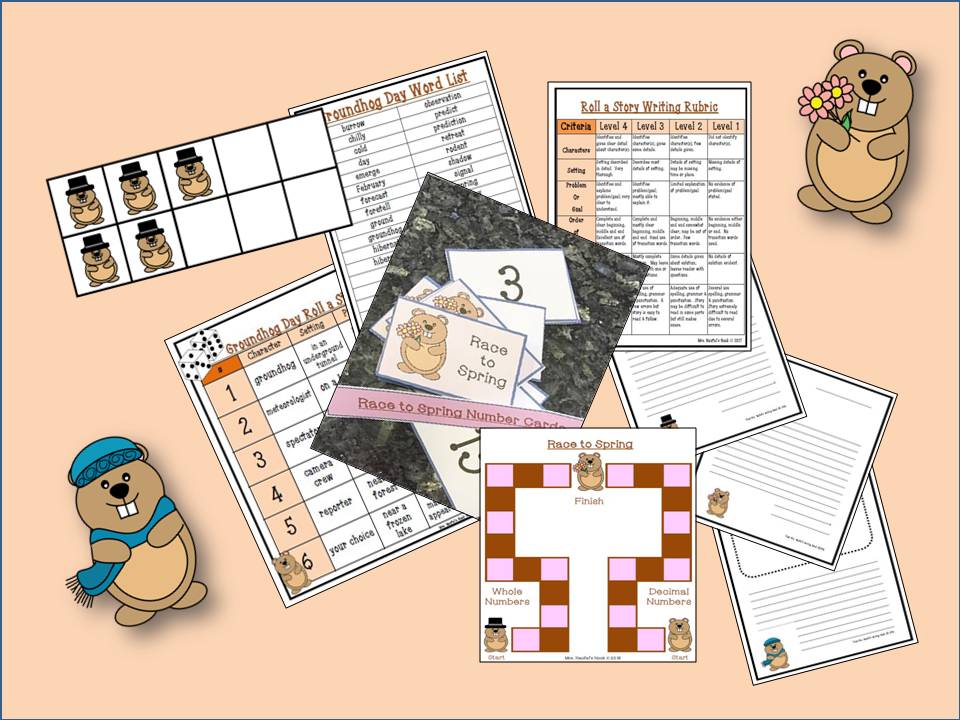
Groundhog Day Math Stations are a fun way to celebrate February 2nd. A Groundhog Day package of games includes 3 games. The first game involves drawing a groundhog based on products (for a multiplication game) or sums (for an addition game). The second game is called Race to 2. Students will use addition or subtraction to move their way back to the number 2 on a hundred chart. The first person to land on 2 is declared the winner. The final game is a race to spring. Whoever reaches the finish line first after dividing numbers is declared the winner. Quotients and outcomes are based on both whole and decimal numbers.

For the younger students, Ten Frame Groundhog Day Clip Art images have been created.  They can easily be placed on card stock and enlarged for a fun math talk. 

Fun Writing Activities:

Roll a Story prompts students to tell or write story with a Groundhog Day theme. This unit includes a story prompt sheet, graphic organizers, word lists (Groundhog Day & transition words), rubric and specialty writing paper with full and half lined pages.  All you need is a 1 to 6 number cube. If students want to continue writing, Groundhog Day themed writing paper is a fun way to display their creative work.


Sunday, 13 January 2019

The Importance of Independent Reading

Are you thinking about some ways to differentiate teaching that supports students in developing reading proficiency?  This is something that I have struggled with over the years.  A highly active classroom often gets the better of me and my independent reading practice goes by the wayside.  The suggestions I provide are not foolproof but they are practical enough for anyone to implement.  Once independent reading is established, the goal is to use this time to work on small group guided reading with your students.  Begin by setting a time for uninterrupted reading.  I usually do this for 20 minutes each day.  Your students will thank you for it!  The "I don't know what to read" will diminish if you give students some choice.  During the first week, we gather with a few read alouds.  As I read aloud, I talk about ways I'm reading the book.  This includes how I hold it, how I read the book jacket, looking for the copyright date, the author, the illustrator and even where it was published.  Students love when we can find out "how old the book is."

I then ask students to select books they may be interested in reading from the classroom library.  The library is filled with bins and labelled genres.

Students are asked to choose 5 books to read at the beginning of the week.  They are then placed in labelled magazine box holders with students' names on them.  Choosing 5 books allows them to not travel back and forth to the classroom library.  They have chosen 5 books just incase one is not appropriate.  Books range from graphic novels, reading series, sports, hobbies, science, math etc. I often keep double copies of my read aloud so that one goes back in the classroom library.  Sticky fingers off my own read aloud selection!

We create an anchor chart for what Independent Reading looks like, sounds like and feel like.  I model Independent Reading time.  I often invite another teacher in to demonstrate or a student I taught from the previous year.  Once students "see" the process, they are able to co-construct an anchor chart.  

Over the next few days, during independent reading time, I interview each student.  I can usually get through 5 a day. This involves taking a reading interest inventory.  

This practice allows me to know what the students might be interested in reading.  Often they have repeatedly said "I don't know what to read" or "I don't like reading."  They slowly realize that they do have an interest in some genre.  When I know what that is, I make an effort to stock my classroom library with things they will like.

Once independent reading time routines are in place, I can begin working on exploring reading levels through running records. This usually happens during the second or third week of school.  Within the first month, reading interests are discovered as well as reading levels.  I am then able to focus on my guided reading groups during independent reading time.  

Saturday, 29 December 2018

Dollar Deals on TpT

It's that time of year again!  The TpT Focused Success group is bringing some fabulous dollar deals your way for two days only!


Search #Ringin2019 on TpT.  For the resources above click on the links below (discount prices end on January 1st, 2019): 


Tuesday, 20 November 2018

Great Activities E-Book Launch


Download this free A 20 page resource e-book from TpT Sellers offers links to free and paid resources for all grade levels and spanning multiple curriculum.


Thursday, 1 November 2018

Remembrance Day Poppy Wreath

This Remembrance Day, have your students create a Poppy Wreath.  Each student can create their own poppy which can be attached to a hanger to create a class poppy wreath.  Directions are listed below: 


Poppy Wreath Instructions
You will need:
- Several sheet of red paper (8 - 1/2  X 11”)
- Sheets of black paper
- Scissors
- Glue
- Something to trace (e.g., small cup)
- Wire hanger
- Heavy duty tape
Instructions:
1.     Bend wire hanger into a circle shape.
2.     Make several copies of the heart template using red paper.
3.    Cut 6 hearts for each poppy.  Crinkle each heart and then glue them together.
4.     Use a small cup to trace a black circle.  Cut the circle and then cut small fringes into the edges.  Glue the black circle into the middle of your poppy.
5.    Attached each poppy to the hanger.  Use heavy duty tape.
6.    To create a full effect, add at least 10 to 12 poppies to the hanger.

Full directions and photos are free at the following link: 


Tuesday, 23 October 2018

Halloween Resource Roundup

That time of year is fast approaching.  Here are some fun activities to use in your classrooms.


Halloween math stations are a fun way to consolidate learning for students in Grades 3 to 6. This package of activities includes a patterning poster project, word cards, poster templates and a rubric to use after working through terms such as increasing patterns, decreasing patterns and repeating patterns. Two criteria checklists have been developed. One uses the slide, flip and turn vocabulary while the other uses translations, reflections and rotations. A sample poster planner is part of this package as well as images to use in the creative part of the poster. Individual patterning practice activities are included, an addition game, multiplication game and a place value game using numbers between 0 and 99.


Halloween is always a fun time of year to introduce literacy activities to your classroom. This bundle contains four Halloween units found in my store. The Halloween Writing Unit contains three forms: descriptive writing, procedural writing and informational writing.  The descriptive writing component is introduced through an Onomatopoeia Poem. With the creation of words that produce natural sounds, students can come up with a creative way to explore the world of poetry. It is recommended that a Halloween CD be used for this activity. If a CD is not available, you may access the internet for Halloween sounds or have students come up with their own.  When writing a procedure, students can come up with a Halloween Recipe that will send shivers down the reader’s spine. A step by step “how to” activity is included to assist in the procedural writing process.  Finally, the informational piece is always a fun one that allows students to publish their work on specialty writing paper. Students will explore fascinating facts about bats and explain why bats exhibit certain characteristics, habits or features. This writing kit includes a writing guide to assist your students, writing forms, display ideas and book covers (if you choose to turn these into class books), specialty writing paper and a rubric. 


A working with words activity will have students in grades 3 through 6 use subject, verb and complement cards to build and simplify silly sentences. Challenging verb cards are included with this unit as well as nouns associated with the Halloween theme, a blank sentence building template, display and label cards and a synonym chart. This is a perfect activity to use in your Word Work Stations or as an extra project for early finishers.


If you would like to start a great home-school connection or addition to your literacy writing station, the Halloween Costumes Write About book is the place to start. A helpful planning sheet is included for your struggling writers. This writing activity will encourage writing at any grade level.


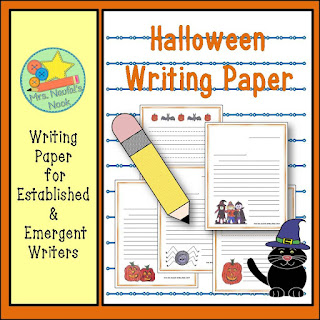
Finally, a package filled with Halloween letter writing paper and lined paper for emergent and established writers is included in this bundle. Art work created includes kids in costumes, jack-o-lanterns, spiders and bats. 


Halloween images are presented in an organized arrangement by number. Students will learn to recognize the number of objects without counting them. This is called “subitizing”. Incorporating these images into daily number chats provides opportunities for students to work on counting, seeing numbers in multiple ways and learning combinations. 

Each page contains 4 of the same image but in different combinations for number chats. You may use one set of 4 images per day. The students can apply the strategies from each picture presented in whole or small group math chats.. 


Make writing fun with this Halloween shaped paper pack. You will find four themes to choose from:  a pumpkin, a witch's hat, a haunted house and a cat. Paper is created for emergent and established writers plus blank form.

Students will be prompted to tell or write a story with a Halloween theme.  This unit includes a story prompt sheet, graphic organizers, word lists (Halloween & transition words), rubric and speciality writing paper with full and half lined pages.


Here's a fun way to assist students in computation of number sums either in math stations, with a buddy or for independent practice. This unit of 25 part-part-whole cards will allow students to practice sums from 2 to 10 with a Halloween theme. The unit includes 2 variations for the numbers 2 and 3 and 3 variations for the numbers 4 to 10. With numbers hidden with flaps, Students can then justify what the missing part is and lift the flap to verify their answers. Cards may be used during a number talks, during guided math groups or for individual assessments. 


\
Here's a free product your trick or treaters will love: Halloween Loot Bag Tags. Just add a loot bag and goodies before placing this tag on the treat bag.